
Why Privately Hosted VDI Is the Smarter Choice for Hybrid Workers and Disaster Recovery
Hybrid working is no longer a temporary arrangement. For most UK businesses, a workforce split between home, office, and other locations is simply how things are now. The question is no longer whether to support flexible working, but how to do it securely, consistently, and without creating a separate disaster recovery problem to solve alongside it. This is one of the reasons many organisations are investing in managed IT services that support modern hybrid working.
Virtual Desktop Infrastructure (VDI) is one of the most effective answers to both challenges at once. When your desktops live on a server in a datacentre rather than on individual laptops and PCs, every user gets the same environment from any device, your data never leaves a controlled location, and if something goes wrong at your office, your team can be working again from anywhere within minutes. As organisations review their cloud services strategy, VDI is increasingly becoming part of the conversation.
But not all VDI is equal. The decision that matters most is not which software platform you use. It is where you host it.
What VDI Actually Is
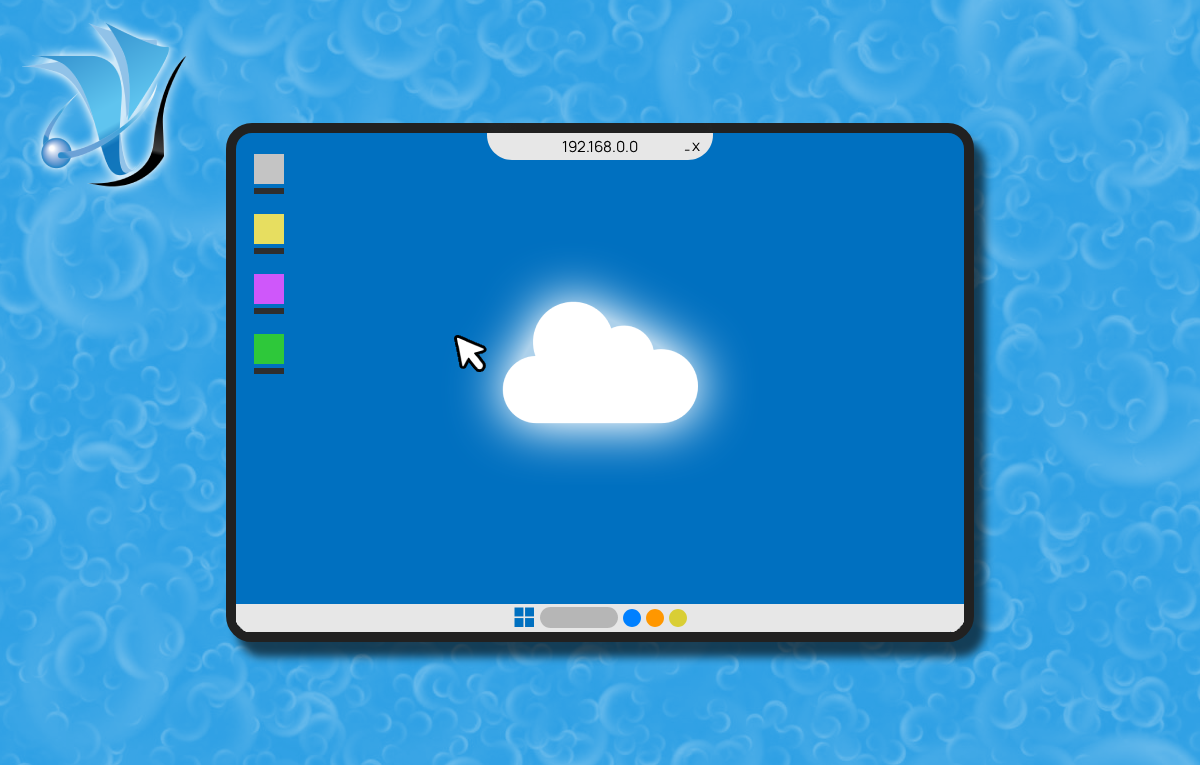
VDI hosts a full Windows desktop environment on a central server. When a user connects, whether from their home laptop, a tablet, a thin client in the office, or a borrowed machine, they see their usual desktop with all their applications and files exactly as they left them. The processing happens on the server. Only screen updates, keyboard input, and mouse movements travel over the network.
This means that the endpoint device is essentially irrelevant. An old laptop that would struggle to run modern applications becomes perfectly capable when it is just displaying the output of a powerful server. A personal device can be used for work without any company data ever touching it. A new starter can be set up in minutes with a fully configured desktop, without anyone needing to physically touch a machine.
Private Hosting Versus Public Cloud: Why It Matters
The mainstream conversation about VDI in 2026 tends to point towards public cloud: Azure Virtual Desktop, Windows 365, or similar services from the major hyperscalers. These are legitimate products, and for some organisations they are the right answer. But for many UK SMEs, privately hosted VDI in a UK datacentre is a significantly better fit, for reasons that are easy to overlook when the marketing emphasis is on cloud-first everything.
Your Data Stays in the UK, Under UK Law
When your VDI is hosted in a private UK datacentre, your data is governed by UK law and UK law alone. That sounds straightforward, but it is more meaningful than it might appear.
The US CLOUD Act (2018) allows American authorities to compel disclosure of data held by US-headquartered companies, regardless of where that data is physically stored. Microsoft, Amazon, and Google are US companies. Their UK datacentres are subject to US legal jurisdiction. That does not mean your data will be accessed, but it does mean you cannot guarantee it will not be, and for clients in regulated sectors, that distinction matters.
A privately hosted VDI environment in a UK-owned datacentre removes that uncertainty entirely. Your data is in a known location, under a known legal framework, with a clear chain of accountability. For businesses handling sensitive client information, financial records, or personal data, this forms an important part of a broader IT and cyber security strategy.
Predictable Performance, Not Variable Cloud Latency
VDI user experience is directly tied to latency. The round trip between a user’s input and what appears on screen needs to be short enough to feel responsive. On a private hosted environment with a direct, dedicated connection, that round trip is fast and consistent. On a public cloud environment, performance depends on internet routing, cloud region load, and the user’s own broadband quality.
For office-based users connecting over a leased line or business broadband to a nearby datacentre, privately hosted VDI typically delivers a noticeably better experience than cloud alternatives routed through congested public internet paths. For most business applications including line-of-business software, Office applications, and web tools, the difference between a well-hosted private VDI and a well-configured cloud equivalent is not dramatic. But it is consistently there, and it compounds across a working day.
Predictable Cost Without Public Cloud Billing Surprises
Public cloud VDI pricing is consumption-based. That model works well for organisations with highly variable desktop demand. For most SMEs with a relatively stable headcount, it means paying a monthly per-user fee that is easy to forecast but rarely cheap, and which can include unexpected egress charges, storage costs, and licensing complexities.
Privately hosted VDI typically runs on a fixed monthly cost covering the server capacity, hosting, management, and support. There are no surprise bills from an unexpected usage spike. The cost profile is straightforward and scales predictably as headcount changes.
Full Control Over Configuration and Security Policy
In a private hosted environment, the configuration is entirely under your IT provider’s control. Security policies, network segmentation, access controls, and integration with your existing systems are all customisable to your specific requirements rather than constrained by a cloud platform’s defaults and available options.
This matters for organisations with specific compliance requirements, for businesses integrating with on-premises line-of-business applications, and for anyone who needs to be able to demonstrate exactly what controls are in place and why. These requirements often sit alongside wider cyber security initiatives designed to protect business-critical systems and data.
The Disaster Recovery Angle That Most Businesses Miss
Here is the part that is easy to overlook when evaluating VDI purely as a remote working solution: a well-implemented VDI environment is also a disaster recovery platform by default.
Consider what happens when something goes seriously wrong at your office. A fire, a flood, a burst pipe, a power failure that takes out your server room, or a ransomware attack that encrypts your on-site systems. In a traditional desktop environment, your team cannot work. Laptops that were in the building are inaccessible or destroyed. Files that lived on local servers are gone or locked. Recovery involves sourcing replacement hardware, restoring backups, reinstalling software, and reconfiguring everything, a process that routinely takes days for SMEs without a dedicated DR plan.
In a VDI environment hosted in a private datacentre, none of that applies. Your desktops and data are in a separate physical location that was not affected by whatever happened at your office. Your team picks up any device, opens a browser or a thin client application, authenticates with MFA, and is working again. The datacentre’s physical security, power redundancy, and cooling infrastructure mean that the kind of events that take out an office server room simply do not affect it.
This is genuine disaster recovery, not a theoretical capability that requires a separate DR exercise and additional infrastructure to activate. It works because hybrid workers were already using it every day.
The Hybrid Working Benefits in Practice
Beyond the DR case, privately hosted VDI solves several practical hybrid working problems that organisations with traditional desktop estates regularly struggle with.
Device independence. When the desktop lives in the datacentre, it does not matter what the user is connecting from. A home laptop, a shared office machine, a tablet, or a thin client all provide the same experience. Replacing a broken laptop means issuing any available device, not rebuilding a specific machine with specific software.
Secure BYOD. Personal devices can be used for work without company data ever residing on them. When a session ends, nothing is left on the endpoint. For staff who work from personal devices, this removes a significant data protection risk without requiring complex MDM configuration of devices the organisation does not own.
Consistent security posture. Updates, patches, and security policies are applied centrally to the desktop images. There is no risk of a remote worker running an outdated, unpatched machine because they have not connected to the VPN recently enough. Every session runs the current, approved environment.
Fast onboarding and offboarding. A new starter gets a fully configured desktop in minutes. When someone leaves, access is revoked centrally and immediately. No chasing returned laptops, no worrying about what data was on a device that did not come back.
Support from anywhere. Your IT provider can connect to and manage any desktop in the environment without needing physical access to user devices. Troubleshooting, software installation, and configuration changes happen centrally, reducing the support overhead of a distributed workforce.
Who It Works Best For
Privately hosted VDI is particularly well suited to:
- Businesses with 10 to 150 users, where a fixed-cost private environment is more cost-effective than per-user cloud pricing
- Organisations in regulated sectors including legal, financial services, healthcare, and accountancy, where data location and access controls are subject to compliance requirements
- Businesses with a genuine DR requirement but without the budget or complexity of a traditional DR site
- Organisations that have struggled with supporting a hybrid workforce on traditional laptop estates and want a simpler, more controllable model
- Businesses that have line-of-business applications running on local servers and need desktops that can reach them reliably
What System Force IT Offers
We host VDI environments for clients from our own UK datacentres in Gloucestershire. That means we know exactly where your data is, we manage the infrastructure directly, and we can offer a level of control and accountability that cloud platforms cannot match. Our datacentre infrastructure includes redundant power, cooling, and connectivity, giving your VDI environment the availability it needs to function as a reliable DR platform as well as a day-to-day working environment.
If you are reviewing your remote working setup, planning for business continuity, or simply frustrated with the complexity and cost of keeping a distributed laptop estate secure and up to date, VDI is worth a conversation.
Get in touch with the System Force IT team to discuss whether privately hosted VDI is the right fit for your organisation.
Stay one step ahead of the threats
Get our free weekly IT and cyber security briefing for UK businesses. The same threat and policy round-up we send our own clients, straight to your inbox. No spam, unsubscribe any time.
Get the free weekly briefing →