
Ask most business owners which of their activities they would recover first after a serious disruption, and you get a confident answer. Ask them how they know, and the confidence usually fades. A business impact analysis is how you replace that gut feel with something you can defend, plan around and act on when it matters. It is the single most valuable piece of business continuity work an SME can do, and it is the part most guides rush.
This is a complete, practical guide to the business impact analysis (BIA) for UK SMEs. It goes well beyond the summary in our main Business Continuity Plan guide: here we work through the whole method, from listing your services to approving the results and turning them into a plan. There is a free BIA workbook that puts all of this into a structured spreadsheet you can complete for your own business.
Free Business Impact Analysis Workbook
Seven guided sheets take you from products and services through impact over time, dependencies and recovery objectives to a clear recovery priority list. Worked examples included, no macros, no sign-up.
What a business impact analysis actually is
A business impact analysis is a structured way of answering two questions for every important thing your business does: how badly would it hurt if this stopped, and how quickly does that hurt grow? From those answers you derive which activities to recover first, how fast, and what they depend on. The internationally recognised business continuity standard ISO 22301 treats the BIA as the foundation of the whole management system, and for good reason: everything downstream, your recovery objectives, your continuity strategies, your plan, is only as sound as the analysis underneath it.
The most common failure is to treat the BIA as an IT asset list. It is not. A BIA is about business activities and outcomes, and the resources they consume are only relevant because they support those outcomes. “We have twelve servers” is inventory. “We must be able to invoice within two days of month-end or we breach a covenant” is a business impact analysis finding. The first tells you what you own; the second tells you what to protect and how urgently.
Why a BIA is not a risk assessment
These two are constantly confused, and keeping them apart makes both far more useful. A BIA asks what happens if an activity becomes unavailable, regardless of the cause. A risk assessment asks what could make it unavailable, and how likely and controllable that is. The BIA does not care whether the cause is a flood, a cyber attack or a burst pipe; it cares about the consequence of the activity stopping. You do the BIA first, because it tells you which activities are important enough to be worth assessing risks and building defences for. Spending your risk-assessment effort on an activity the business could lose for a fortnight without noticing is effort wasted.
Step one: list your business activities and services
Start at the top, with what your business delivers to its customers, then break each service into the activities that produce it. Keep the language in business terms. A professional firm might list “responding to client instructions”, “producing and issuing work”, “billing and collecting payment”, “paying staff and suppliers”. A distributor might list “taking orders”, “picking and packing”, “dispatch”, “restocking”, “customer support”. Aim for a manageable number of genuinely distinct activities, not a hundred micro-tasks.
For each activity, record the basics that frame everything else: who owns it, who the customers and stakeholders are, its normal operating hours, and its busy or critical periods. Timing matters more than people expect. A payroll run is trivially interruptible for three weeks of the month and business-critical for the two days around payday. A BIA that ignores timing produces recovery targets that are either needlessly expensive or dangerously slack.
Customers, contracts and commitments
Before you score the pain, capture what you are actually on the hook for. For each important activity, note the customer expectations, contractual commitments, service levels, and any deadlines that carry a penalty or a lost-order consequence. These are the hard edges that turn a vague “customers would be annoyed” into a concrete “we have a contractual four-hour response commitment with two clients”. Contractual obligations frequently set tighter recovery targets than the business would otherwise choose, so they belong in the analysis, not in a separate legal folder nobody reads during a disruption.
The consequences you need to assess
Impact is not one thing, and scoring it as a single “how bad” number hides the detail that drives good decisions. Assess each important activity across several distinct consequence types. A given outage might be mild financially but severe reputationally, or trivial operationally but serious for safety. Looking at each separately is what stops a BIA collapsing into hand-waving.
Operational consequences
What actually stops working, what backs up, and what knock-on effects ripple through the rest of the business. An order-taking outage does not just pause orders; it stalls dispatch, invoicing and cash.
Financial consequences
Lost revenue, wasted cost, penalties, and the cost of the workaround itself. This is where our Downtime Cost Calculator turns a guess into a figure you can plan against.
Regulatory and legal consequences
Reporting duties, licence conditions, data-protection obligations and contractual breaches. Some sectors carry genuinely tight requirements; most SMEs face customer and insurer expectations rather than statute.
Reputational consequences
The damage to trust with customers, partners and staff, which often outlasts the operational outage and is the hardest to repair.
Safety and welfare implications
Any activity where degradation could put people at risk, or where an outage puts unreasonable strain on staff. Safety-critical activities cannot simply be “run slower”.
Customer impact
The direct effect on the people who rely on you, and whether they have an alternative or are stranded.
You do not need a scientific model. A simple Low, Medium, High, Critical rating per consequence type, with a sentence of justification, is more useful than a false-precision weighted score that nobody can explain. The point is to understand why an activity is a priority, not to generate a number.
Impact grows over time, so measure it over time
This is the idea that turns a BIA from a static list into a planning tool. The impact of losing an activity is not a fixed value; it is a curve that rises the longer the outage lasts. Ten minutes without your order system is an irritation. Half a day is a problem. Three days is a business event with lasting customer damage. So instead of asking “how bad is it”, ask “how bad is it after one hour, after four hours, after a day, after a week”.
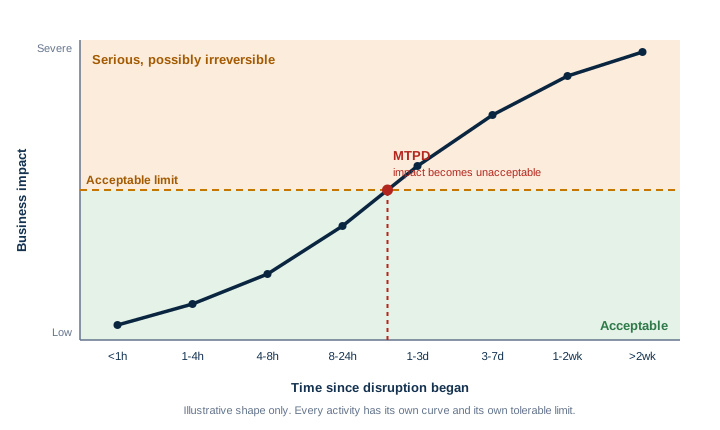
Score the impact across a set of time bands. A workable default, which you should adapt to your business, is: under 1 hour, 1 to 4 hours, 4 to 8 hours, 8 to 24 hours, 1 to 3 days, 3 to 7 days, 1 to 2 weeks, and more than 2 weeks. A bakery cares about hours; a project-based consultancy might think in days. The band where impact tips from tolerable to serious is the maximum tolerable period of disruption for that activity, the point beyond which the damage may become irreversible. Terminology varies between frameworks, so do not chase false precision; the value is in identifying roughly where the cliff edge is, so your recovery target can sit comfortably before it.
From impact to recovery priorities
Once you know how quickly impact grows for each activity, a recovery order falls out almost automatically. Activities whose impact becomes serious within hours are your top priority; those you could lose for days without lasting harm sit lower. The discipline here is honesty: everything cannot be priority one. If your BIA marks every activity as critical, it has failed, because your team will freeze trying to recover everything at once. A useful model, adaptable to your business, runs from a top band of safety and emergency obligations, through services needed within hours, within a business day, tolerable for several days, and finally those that can wait until core operations are back. The recovery target you set for each activity, its recovery time objective, comes straight from where its impact crosses the line. We cover setting those targets properly in our companion guide, RTO vs RPO explained.
Capture the dependencies while you are there
A recovery target is meaningless unless you know what the activity depends on, so the BIA is the natural place to capture dependencies. For each priority activity, note what it relies on across people, premises, technology, communications, data, suppliers, utilities and equipment. Look especially for single points of failure, the one person, supplier, system or line whose loss stops the activity with no alternative, and for the indirect dependencies that catch businesses out. “Our finance system is in the cloud” hides a chain of internet, identity, multi-factor authentication, the user’s device, power and a bank portal, any of which can take the “resilient” cloud service offline. The dependency work you do in the BIA becomes the raw material for your continuity strategies.
Minimum viable operations and workarounds
For each priority activity, the BIA should also ask: what is the smallest, safe level at which we could keep this going while we recover? This minimum viable operation, a term the NCSC uses in its recovery guidance, is what you aim for first in a real disruption, before full service. Alongside it, note any manual workaround, and be honest about its limits: how much volume it can handle, and, crucially, how you would reconcile the work once systems return without creating duplicates, missed orders or double invoices. A workaround with no reconciliation plan is a problem deferred, not solved.
Gathering the information: talk to the people who do the work
A BIA written at a desk by one person is a guess in a spreadsheet. The people who actually run each activity know things the org chart does not: the informal workaround, the one supplier nobody documented, the report that only one person can produce. Interview them. A short, structured conversation with each process owner is worth more than any template.
- Ask what they actually do, in order, on a normal day, and what they need to do it.
- Ask what breaks it. “What has stopped you working in the past, even for an hour?” surfaces real dependencies fast.
- Ask about timing. When in the week, month or year would an outage hurt most?
- Ask who else is affected upstream and downstream, to find the knock-on dependencies.
- Ask what they would do if the usual system were unavailable. Their answer is your workaround, or the evidence that there isn’t one.
Review, challenge and approve the results
A BIA is a set of business judgements, so it needs business sign-off. Pull the findings together, look across the whole organisation rather than one area at a time, and challenge the outliers: is that activity really critical within an hour, or does it just feel that way to its owner? Does the recovery order make sense when you read it end to end? Then have it approved by someone with the authority to commit to the priorities and, later, to the spending they imply. Recording who approved the BIA and when matters, because these priorities will drive real decisions during a disruption, and you want them owned, not improvised.
Turning BIA findings into a continuity plan
The BIA is not the destination; it is the foundation the plan is built on. Its findings feed directly into the continuity plan: the priority activities become your recovery sequence, the time bands become your recovery time objectives, the dependencies drive your continuity strategies, and the minimum viable operations shape your first response. Work the BIA through the full method in our Business Continuity Plan guide, and keep the BIA itself as a living document, reviewed whenever the business changes materially, so the plan never drifts away from reality.
Worked example: a fictional 25-person firm
To show that a BIA is about the whole business and not just IT, here is a short, clearly fictional example for a 25-person UK architecture practice. Its main services are responding to client instructions, producing and issuing drawings and reports, and billing. Running a BIA across people, premises, suppliers, communications, technology and information produces a picture no IT asset list would give:
| Dimension | What the BIA reveals |
|---|---|
| People | Two senior architects sign off all issued work. If both are unavailable, work can be produced but not issued, so issuing has a tighter tolerance than production. A clear single point of failure and cross-training gap. |
| Premises | Most work can be done remotely, but the large-format plotter and the physical drawing archive are on site. Losing the building slows issuing and archive retrieval, not day-to-day design. |
| Suppliers | A single cloud design-and-collaboration platform underpins almost everything. Its outage, or the loss of access to it, is the practice’s biggest single dependency, well ahead of any local hardware. |
| Communications | Clients expect same-day responses. If email and the phone system (both cloud) go down together, the reputational impact starts within hours, faster than the operational impact of paused design work. |
| Technology | Identity is the keystone: lose Microsoft 365 authentication and design, email and phones all stop at once. That makes identity the top resilience priority, not the servers. |
| Information | Current project files change constantly, so their acceptable data-loss window is short. The archive rarely changes, so its window is long. Two very different recovery-point needs from what looks like “our files”. |
The BIA’s conclusion for this fictional practice is not “protect the servers”. It is: identity and client communication are the most time-critical, issuing is constrained by a two-person bottleneck, the cloud design platform is the dominant single point of failure, and current project data needs a much tighter recovery point than the archive. A distributor or a manufacturer running the same method would reach an entirely different set of priorities. That is the point: the BIA finds your priorities, not a generic list.
Not sure where your business stands?
Take the free 5-minute Business Continuity Readiness Check for an instant readiness level and your top actions. No sign-up, nothing stored.
Frequently asked questions
A business impact analysis (BIA) is a structured way of working out, for each important activity in your business, how badly it would hurt if it stopped and how quickly that hurt grows over time. From that you derive which activities to recover first, how fast, and what they depend on. It is the foundation of a credible business continuity plan.
List your services and the activities that deliver them; capture customers, contracts and commitments; assess the operational, financial, regulatory, reputational and safety consequences of losing each; score how the impact grows across time bands to find the maximum tolerable period of disruption; derive recovery priorities and objectives; capture dependencies and minimum viable operations; then review and approve the results. Interviewing the people who run each activity is essential.
A BIA asks what happens if an activity becomes unavailable, whatever the cause. A risk assessment asks what could make it unavailable, and how likely and controllable that is. You do the BIA first, because it tells you which activities are important enough to be worth assessing risks for.
It is broadly the point at which an outage becomes unacceptable to the business, after which the damage may be irreversible. You find it by scoring how impact grows over time until it crosses from tolerable to serious. Your recovery target should sit comfortably before that point.
No. A BIA is about business activities and outcomes across people, premises, suppliers, communications, technology and information. Technology is only relevant because it supports those activities. Treating a BIA as an IT asset list is the most common mistake, and it produces recovery priorities that miss what actually matters.
No. This guide and the free BIA workbook align with generally recognised business continuity principles and can help you work in that direction, but they do not provide ISO 22301 certification, which is a separate, audited process. Note that System Force IT’s ISO/IEC 27001 certification is for information security, a different standard from ISO 22301.
Related reading: the full Business Continuity Plan guide, RTO vs RPO explained, the free Business Continuity & BIA Toolkit, and the Downtime Cost Calculator. If a cyber attack is what causes a disruption, our Incident Response Toolkit handles containing the threat while continuity keeps the business running.
Get the toolkit
The BIA workbook plus fifteen more editable continuity templates, free and ungated.
Want help running your BIA?
We can facilitate a business impact analysis with your team and turn it into a working plan.
Stay one step ahead of the threats
Get our free weekly IT and cyber security briefing for UK businesses. The same threat and policy round-up we send our own clients, straight to your inbox. No spam, unsubscribe any time.
Get the free weekly briefing →